On this page
The short version
- A demo account uses virtual money on the same platform you would use live, making it the safe place to learn order types, charts and margin mechanics.
- Demo prices can be delayed or simulated, so demo fills are not proof of live execution quality.
- Simulated success does not carry over: simulators don't reproduce the emotional side of trading real money and can breed overconfidence.
- Move to live with the smallest position size, treat live as a new learning phase, and keep a demo for strategy testing.
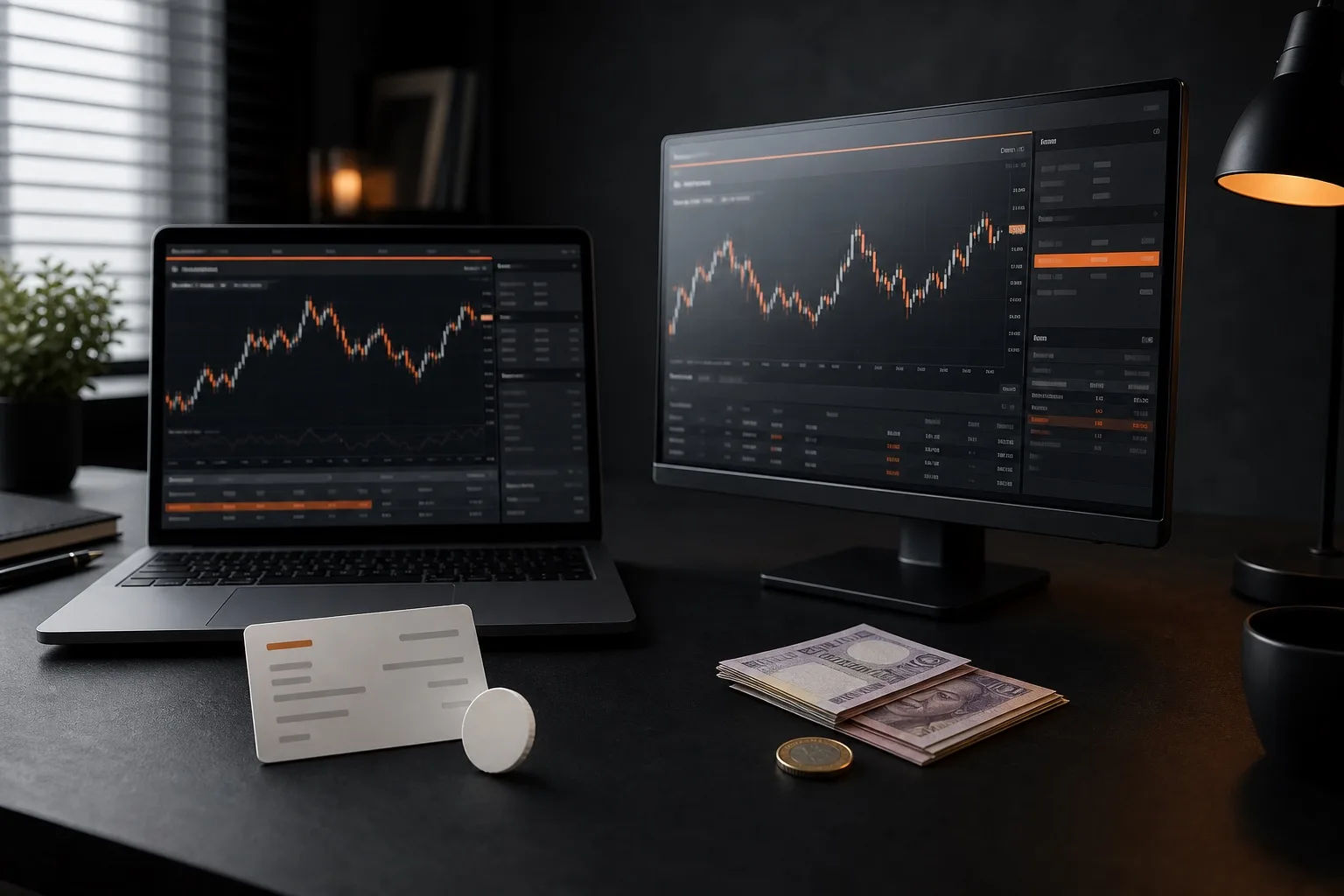
In forex, a demo account and a live account look almost identical on the screen. The platform is the same, the charts are the same, the order tickets are the same. What changes is what sits behind the numbers: simulated money versus your own. Understanding exactly what differs — and what doesn't — is the difference between a demo that actually prepares you and one that quietly teaches bad habits.
What a demo account actually is
A demo account (also called a paper trading or practice account) is a simulated trading environment in which you place trades using virtual money instead of real funds. Stock market simulators "reproduce behavior and features of a market so that a user may practice trading without financial risk" (Wikipedia, Paper trading). In forex specifically, a demo account mirrors a broker's live platform: you see the same currency pairs, the same charting tools, and the same order types, and you can open and close positions as if the money were real.
Brokers offer demos for a practical reason: retail forex only became possible when electronic platforms let individuals access the currency markets from their own computers (Wikipedia, Retail foreign exchange trading). Before anyone risks funds on that software, they need a safe way to learn it.
What stays the same — and what doesn't
The interface and mechanics are usually identical between a broker's demo and live environments. The differences tend to sit in three areas, and knowing them prevents surprises later.
Prices and data. Some simulators rely on delayed market data — Wikipedia notes feeds delayed by roughly 15 to 20 minutes on some simulators — and others simulate prices rather than streaming the live market. If your demo prices lag the real market, fills you observe there will not translate one-to-one to live conditions. Check whether your demo streams live quotes before drawing conclusions about speed.
Execution and liquidity. A live account trades against real liquidity, and outcomes like slippage and requotes depend on market conditions at that moment. A demo environment can fill orders more smoothly than the live market would, especially during volatile periods.
The money. In a demo, losses cost nothing and gains are not yours. That single fact changes behavior more than any technical difference — which is the next point.
What a demo account is good for
Used deliberately, a demo is the right tool for several jobs:
Learning the platform. Placing market, limit, and stop orders; setting stop-loss and take-profit levels; reading the positions panel. These are mechanical skills where mistakes should be free.
Testing strategies without financial risk. Investors use paper trading to compare how different positions behave as markets move (Wikipedia, Paper trading). A demo lets you test an approach on EUR/USD and on gold side by side before committing capital.
Understanding leverage and margin mechanics on paper. As an illustrative example only: a 0.1-lot EUR/USD position (10,000 units) moves about $1 per pip. A 25-pip adverse move is a $25 loss — the same arithmetic whether the account is demo or live, but the margin required depends on the leverage offered. At a 1:30 cap on a notional of $10,800, margin is roughly $360; at 1:500 it is roughly $22. Working through these numbers in a demo, where being wrong costs nothing, is exactly what the environment is for.
Deciding whether a broker's platform suits you before opening a funded account.
What a demo cannot teach
Wikipedia's limitations section is blunt: simulators "may not replicate the emotional and psychological aspects of real trading and can simplify trading mechanics," which "may contribute to overconfidence when users transition to live financial markets."
This is the single most important caveat in this article. A demo result is not evidence of how you will trade with real money. When every loss is imaginary, holding through a drawdown is easy; when the money is yours, the same decision feels completely different. A common and costly pattern is a trader who performs well on demo for weeks, moves to live, and immediately takes larger positions or abandons their stop-losses because the emotional context changed.
Demo performance also says nothing about a broker's live execution quality, and it does not measure how you handle losing streaks — which, in leveraged trading, is a core skill. A significant share of retail CFD and forex accounts lose money, which is why brokers are required to disclose loss percentages prominently (capital.com's own site banner is an example of this disclosure in practice).
Practical details worth checking
Demo accounts are not all identical. Before you rely on one, check:
Expiry. Some firms allow time-limited demo accounts — Wikipedia cites examples of 14-day demo accounts. If yours expires, confirm you can extend or reopen it rather than losing your trade history mid-learning.
Balance realism. A demo pre-loaded with $100,000 invites position sizes you will never afford live. Set your virtual balance close to what you would actually deposit.
Data latency. As above — delayed or simulated prices limit what you can conclude about fills and speed.
Instrument coverage. Some demos carry fewer instruments or different symbol lists than the live platform.
Moving from demo to live
There is no universal moment to switch, but the transition itself deserves respect:
Start smaller than your demo size. Even if your demo record is strong, begin live with the smallest position size your broker allows. The first goal of a live account is not profit — it's learning how you behave with real money at stake.
Treat live trading as a new data set. Your demo statistics reset, psychologically, on day one. Expect your execution and discipline to differ, and review trades against that expectation.
Do not chase demo results. A strong demo period is a reason to proceed carefully, not to increase risk aggressively. Overconfidence after simulated success is the documented failure mode, not a myth.
Keep a demo for testing. Experienced traders keep a demo alongside their live account for testing new strategies or platform features, so experiments never touch real funds.
The takeaway
A demo account is the correct first step in forex: free of financial risk, mechanically faithful to the live platform, and ideal for learning order types, margin arithmetic, and platform navigation. Its limit is equally clear — it cannot simulate what real money does to your decisions. Use the demo to make your mechanical mistakes, move to live small, and treat the switch as the start of a second, harder learning phase rather than a continuation of the first.
Trading forex and CFDs on leverage involves substantial risk of loss and is not suitable for everyone. Nothing in this article is financial advice.
Sources & further reading
Check the original source for its scope, publication date and latest terms.
- Paper trading — Wikipediahttps://en.wikipedia.org/wiki/Paper_trading
- Retail foreign exchange trading — Wikipediahttps://en.wikipedia.org/wiki/Retail_foreign_exchange_trading
For education and research, not personal investment advice. Trading involves risk. Broker terms and protections depend on your country, account and contracting legal entity.