On this page
The short version
- Depth of market shows resting bids and asks stacked by price level; the top of book is the highest bid and lowest ask, and the gap between them is the spread.
- Forex is a decentralized OTC market — about $9.6 trillion traded per day in April 2025 — so there is no single authoritative FX order book any platform can display.
- A retail DOM panel is your broker's aggregated liquidity picture, and some platforms provide depth only for selected symbols.
- Market orders consume displayed liquidity level by level; the volume-weighted average of the swept levels, not the top-of-book price, is your fill.
- Use the ladder as execution context — where liquidity is thin and what your realistic slippage is — not as a standalone trading signal.
Depth of market in forex: why the ladder you see isn't the whole market
If you have ever opened the depth-of-market panel in a trading platform and wondered why the same currency pair can show a ladder of prices on one broker and only two numbers on another, you have run into one of forex's quiet quirks. Depth of market (DOM) looks like a universal feature — a list of bids and asks stacked by price with volumes beside them — but in foreign exchange, what that list actually represents depends entirely on who is showing it to you.
This article explains what depth of market is, why forex has no single true order book, what your broker's DOM panel really displays, and how a market order actually travels through the prices you see on that ladder.
What depth of market shows
An order book is the list of orders a trading venue holds from buyers and sellers: each entry carries a price, a quantity, and a side. When several orders sit at the same price, they form a "price level." The highest bid and the lowest ask together are the "top of the book," and the gap between them is the bid-ask spread [1].
Depth of market is the view of that book beyond the top. Formally, market depth is a real-time list of the quantity available at each price level, organized by price; if a market is deep, it takes a large order to move the price, and if it is shallow, even a modest order can [2]. The "book depth" is simply the number of price levels visible at a given moment — some venues show a fixed number of levels, others show everything [1].
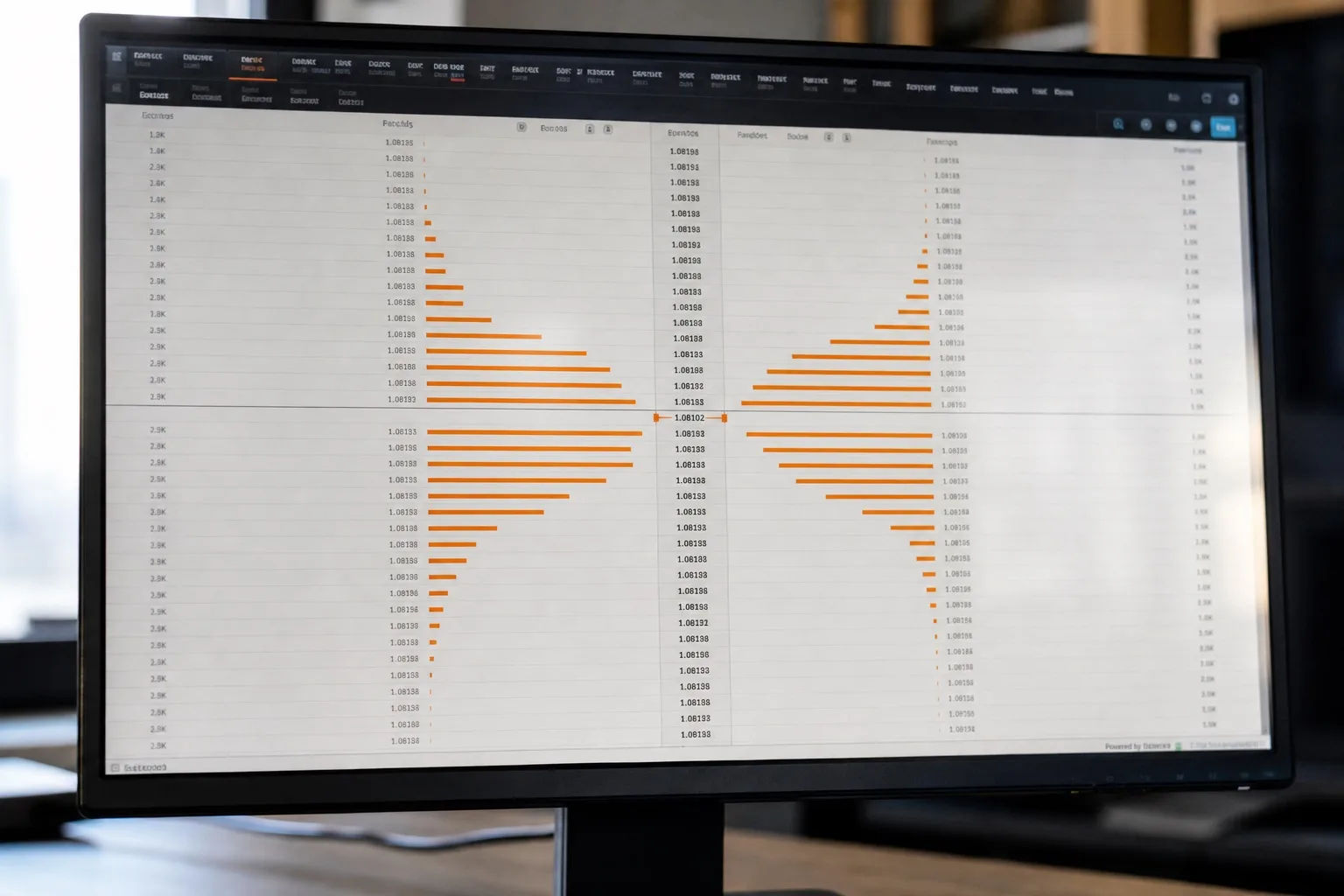
On a screen, this usually appears as a ladder or a depth chart: bids stacked below the current price, asks above it, volumes or notional amounts beside each level, and sometimes a cumulative curve showing how much size sits within each price increment.
Why forex has no single true order book
Here is the part that trips up traders coming from stocks or futures. When you look at a listed equity, you are looking at one centralized limit order book maintained by an exchange. Foreign exchange is different: it is an over-the-counter (OTC) market, a network of dealing relationships rather than a single venue with a public book.
The Bank for International Settlements' Triennial Central Bank Survey — the most comprehensive source of information on the size and structure of global OTC markets — put global OTC FX turnover at an average of $9.6 trillion per day in April 2025, traded across dealer networks rather than a central exchange [3]. There is no single place where all EUR/USD buy and sell interest accumulates, so there is no single authoritative EUR/USD order book for a retail platform to display.
This is worth stating plainly: any forex DOM you see is somebody's book, not the market's book. It is a window into one counterparty's available liquidity, drawn from whatever price sources that counterparty aggregates.
What your broker's DOM panel actually displays
For a retail trader, the DOM in your platform reflects your broker's liquidity picture, not the interbank market's. Under the hood it is typically assembled from quotes the broker receives from its liquidity providers — banks and non-bank market makers — aggregated into price levels.
That has three practical consequences.
Coverage varies by symbol and broker. Platform documentation is explicit about this. In MetaTrader 5, the MqlBookInfo structure provides "information about the market depth data," and the documentation notes that "the DOM is available only for some symbols" [4]. If your broker's price feed for a given pair includes depth data, you get a ladder; if it does not, you get only the top of book — a single bid and ask.
Levels are a sample, not a census. The ladder shows the depth your broker can currently access or is willing to expose. Orders resting at other institutions, or interest your broker chose not to display, simply do not appear. Market-depth research notes that transparency about sizes beyond the best bid and ask "is sometimes hidden for reasons of technical complexity or simplicity," and that reduced information can affect participants' willingness to add liquidity at all [2].
The displayed depth sets expectations, not guarantees. What appears at a price level is what your broker expects to fill at that price right now. It can change between the moment you look and the moment your order arrives, which is exactly why slippage exists even when the ladder looked comfortably deep.
Reading the ladder: how a market order walks the book
A market order does not execute at "the price." It consumes the displayed liquidity level by level, taking the top of book first and then walking outward. The average price you receive is the volume-weighted average of the levels your order swept.
Here is an illustrative example with round numbers (this is a constructed scenario, not a real broker's ladder):
You want to buy 5.0 standard lots of EUR/USD — 500,000 euros — with a market order.
The displayed ask side shows:
Price | Available size |
|---|---|
1.08501 | 150,000 |
1.08502 | 220,000 |
1.08503 | 180,000 |
1.08504 | 400,000 |
The top level fills 150,000 of your 500,000. The second level adds 220,000. The third level covers the remaining 130,000. Your order never reaches the fourth level.
Your average fill price is 1.08502 — computed as (150,000 × 1.08501 + 220,000 × 1.08502 + 130,000 × 1.08503) ÷ 500,000.
Compared with the top-of-book price you saw when you clicked, you paid 0.1 pip more, about $4.80 extra on a 500,000-euro order. The full displayed depth across all four levels was 950,000, so a 5-lot order walked only part of the ladder.
Two lessons fall out of the arithmetic. First, "the price" on a small retail order is usually the top of book, and walking the ladder is rare at retail sizes — which is why the effect is easy to ignore until size or volatility increases. Second, the depth beyond level one is your early-warning system: when those levels thin out before news events or session opens, the same order size will cost more to execute than it would have an hour earlier.
DOM, time and sales, and the limits of what you can see
A depth ladder is a snapshot of resting, displayed interest at one instant. It is not:
A record of what traded. That is time and sales / tick history, a different feed.
A guarantee of available liquidity. In an OTC market, displayed depth can be withdrawn, repriced, or subject to the liquidity provider's acceptance rules before your fill is confirmed.
The whole market. By construction it cannot show liquidity that sits at other institutions. In listed markets, research on order books distinguishes between displayed and hidden interest; in FX the displayed share is whatever the aggregator chooses to expose [1][2].
It is also not a reliable standalone signal. Popular "ladder reading" tactics — fading large levels, chasing imbalances — assume the displayed size is firm intent, but in retail forex the size is usually an aggregate of provider quotes that can vanish without notice. Treat DOM as execution context: where is liquidity thin right now, how deep is the book around my entry, and what is my realistic slippage if this order is large or the tape is fast.
What this means for your trading decisions
Check whether your broker even provides DOM. Many retail feeds show only top of book. If ladder depth matters to your strategy — scalping, large position sizes, news trading — confirm which symbols carry depth before committing.
Weight DOM evidence by source. A deep ladder at one broker tells you that broker's liquidity is good right now, not that the market is deep. Comparing the same symbol across two brokers at the same moment is often more informative than staring at one ladder.
Match position size to visible depth. If your typical order is a meaningful fraction of the displayed depth at the top two or three levels, expect your fills to average worse than the headline price, and size accordingly.
Remember the market context. With roughly $9.6 trillion changing hands daily across a decentralized dealer network [3], liquidity in forex is generally abundant in the majors — but abundance is not uniformity. The ladder you are shown is one broker's view of it.
Depth of market is one of the most misunderstood panels in retail forex, largely because the interface looks identical to an exchange's order book while representing something fundamentally less complete. Once you know it is a window into one counterparty's liquidity rather than the market's ledger, the ladder stops being a mystery — and becomes what it should be: a practical, partial map of where your order will actually travel.
Sources & further reading
Check the original source for its scope, publication date and latest terms.
- BIS Triennial Central Bank Survey — OTC foreign exchange turnover in April 2025https://www.bis.org/statistics/rpfx25_fx.htm
- Wikipedia — Order book (trading)https://en.wikipedia.org/wiki/Order_book_(trading)
- Wikipedia — Market depthhttps://en.wikipedia.org/wiki/Depth_of_market
- MQL5 Reference — Order Book Structure (MqlBookInfo)https://www.mql5.com/en/docs/constants/structures/mqlbookinfo
For education and research, not personal investment advice. Trading involves risk. Broker terms and protections depend on your country, account and contracting legal entity.