On this page
The short version
- A trailing stop keeps a fixed distance (in pips or percent) behind the best price reached, and only moves in the direction that reduces risk.
- It locks in the peak minus your distance, not the peak itself — tight trails can stop a trade out at roughly breakeven in choppy markets.
- Stop triggers do not cap the exit price: gaps and slippage can make the fill worse than the level.
- Whether the trailing logic runs server-side or client-side determines whether it keeps trailing when your platform is offline — check your broker's documentation.
- Trailing and fixed stops encode different intents; neither is a universal winner, and many traders combine them.
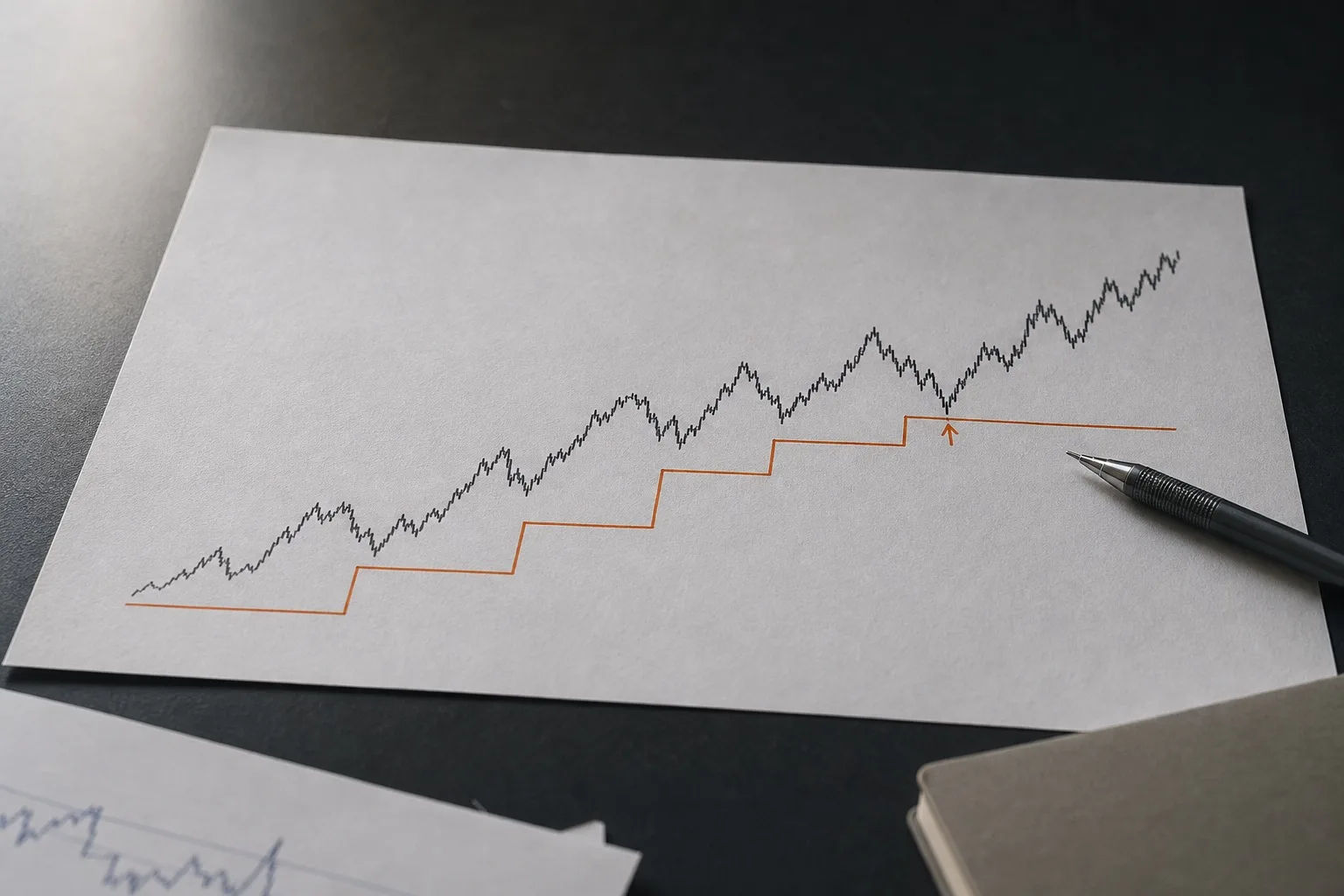
A fixed stop loss answers one question: how much am I willing to lose on this trade? A trailing stop adds a second instruction — if the market moves in my favor, move my protection with it. The stop level follows the price as it improves, and never moves the other way.
What a trailing stop is
A trailing stop order is a stop order whose trigger level is defined by a distance — a fixed number of pips, or a percentage of the price — rather than a fixed price level.[1] As the market price moves in your favor, the trigger level moves with it, keeping the same distance behind the best price reached so far. When the price moves against you by that distance from its best level, the stop triggers.
Two properties follow directly from this definition:
The stop only moves in the direction that reduces your risk. For a long position, it only rises; for a short position, it only falls. If the price retreats, the stop stays where it is.
The distance you choose is the whole strategy. A small distance stops you out on ordinary noise; a large distance gives back a lot of open profit before it fires.
Trailing stops are a standard order type on most retail platforms. The mechanics are the same whether you trade EUR/USD or gold CFDs — only the pip value and typical distance differ.
How the stop trails: an illustrative walkthrough
The example below is illustrative only — it uses hypothetical prices to show the arithmetic, not a real broker's quote history. For a long EUR/USD position, suppose you buy at 1.0850 and set a trailing stop of 40 pips (0.0040).
At entry, the stop sits at 1.0810 (1.0850 minus 40 pips) — identical to a fixed stop at that level.
The price rises to 1.0930. The best price so far is now 1.0930, so the stop trails up to 1.0890.
The price rises again to 1.1010. The stop moves up to 1.0970.
The price then falls back. It does not need to reach your entry to close the trade — it only needs to fall 40 pips from its peak. At 1.0970, the stop triggers and the position exits at roughly that level.
Locked-in result: 1.0970 − 1.0850 = 120 pips of profit, without you having moved the stop by hand. Compare that with a fixed stop left at 1.0810 the whole time: if the price had fallen from the same peak, the fixed stop would still have been sitting 40 pips below your entry, and the extra ~160 pips of gain from 1.0810 to 1.0970 would have been surrendered.
What a trailing stop does not guarantee
It locks in "the peak minus your distance", not the peak. In the walkthrough, the trade gave back the last 40 pips of the run before exiting.
In a choppy, range-bound market, a trailing stop that is too tight can stop a position out at roughly breakeven — the price wobbles up far enough to drag the stop up, then ticks down the distance and closes the trade — after which the trend resumes without you. This is the main trade-off, not a malfunction.
Execution is not guaranteed at the exact trigger level. Trailing stops trigger like any stop order: if the market gaps or the price jumps past your level, the exit price can be worse than the trigger (slippage). A stop does not cap the exit price.
Whether the trailing logic runs on the broker's server or inside your own platform matters. A server-side trailing stop keeps working if your computer or connection drops; a client-side trailing stop (the platform adjusting the stop locally) does not — if the platform is offline, the stop stops trailing. Check your platform's documentation to know which you are using, because availability and behavior vary by broker.
Trailing stop vs fixed stop
Neither is a universal winner — they encode different intents:
A fixed stop expresses a structural view: "my idea is wrong below this level." It does not drift when the price moves up, so it keeps protecting the original risk ceiling and suits setups where the invalidation level is a concrete price (below support, above resistance).
A trailing stop expresses a process view: "protect gains as they accrue." It suits trades that are meant to run, and it removes the manual chore of ratcheting a stop up by hand. The cost is that it exits on distance-from-peak, which is not always where your structural view would say to exit.
Many traders use both: a fixed stop near the invalidation level from the start, then switch to trailing — or tighten the trail — once the position is sufficiently in profit. There is no evidence-based rule for the "right" distance; it depends on the instrument's volatility and your timeframe. A trail sized below the instrument's normal hourly noise will fire early; sizing it is a judgment call, not a formula.
Variants and related orders
A trailing stop-limit behaves the same way while the price moves in your favor, but when triggered it becomes a limit order rather than a market order.[1] That gives some control over the exit price at the cost of possibly not filling at all if the market moves straight through your limit.
One-cancels-other (OCO) setups commonly pair a profit-taking limit order with a stop, and some traders use OCO to replace a manual trailing stop with a stepped set of bracketed exits. Platform support varies.
Platform differences and cost
Most retail brokers do not charge a separate fee for placing a trailing stop — the cost surfaces in the same places as any order: the spread, any commission, and possible slippage at execution. A few brokers sell guaranteed stop levels at a fixed premium; that is a different product from a trailing stop and is usually a fixed-price stop, not a moving one. Terms differ between brokers and jurisdictions, so verify with your own broker's documentation before relying on either.
Key risk reminder
Leveraged forex trading involves substantial risk of loss. A trailing stop limits how far a position can fall below its best price, but it does not prevent losses — before your first favorable move, a trailing stop behaves exactly like a fixed stop at the same distance — and it does not guarantee any exit price. Choose distances and position sizes accordingly, and never rely on stop orders to make a risky position acceptable.
Sources & further reading
Check the original source for its scope, publication date and latest terms.
- Wikipedia — Order (exchange): Trailing stop orderhttps://en.wikipedia.org/wiki/Order_(exchange)
For education and research, not personal investment advice. Trading involves risk. Broker terms and protections depend on your country, account and contracting legal entity.