On this page
The short version
- Slippage is the gap between the price you expect and your actual fill price — it can be negative or positive and is a cost of execution, not a fee.
- Spreads widen around high-impact news because liquidity providers defensively reprice quote risk; the response is structural, not arbitrary.
- Requotes, market execution and last look allocate execution risk differently — 'no requotes' is not the same promise as 'no slippage'.
- Limit vs market orders is the core trade-off: guaranteed price with possible no fill, or guaranteed fill with possible slippage.
- Position sizing and session choice are the cheapest ways to reduce news-time execution costs; nothing eliminates slippage.
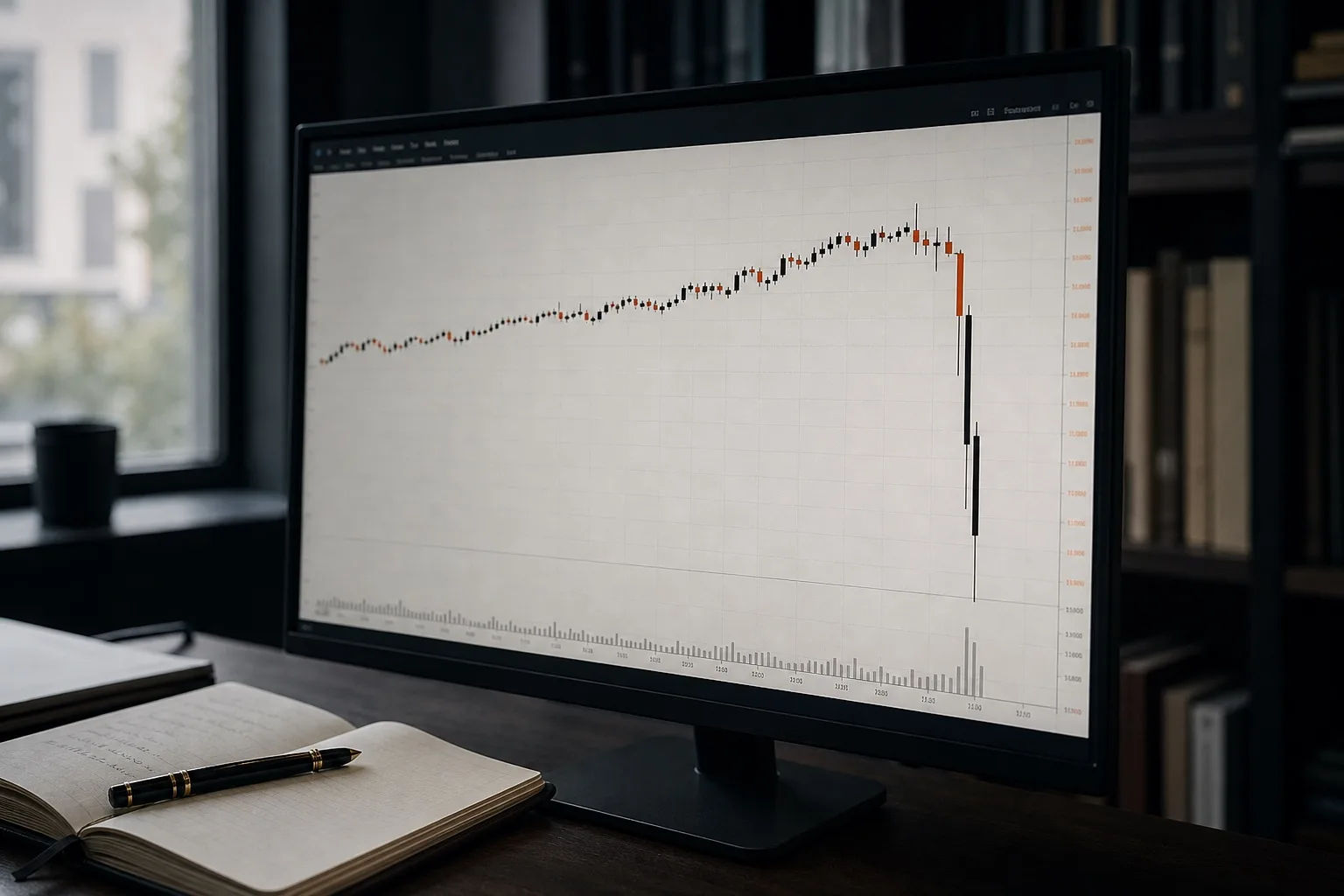
Every retail trader has seen it: you click "buy" on EUR/USD at 1.0950 seconds before a US inflation print, and the fill comes back at 1.0956. Nothing about the market's direction changed — but your entry cost just did. That gap between the price you expected and the price you actually got is slippage, and around high-impact news it is not a malfunction. It is what happens when liquidity thins out faster than quotes can update.
This article explains what slippage is, why spreads widen around economic releases, what requotes and last-look mechanics actually are, and which parts of execution a retail trader can realistically control. It is education, not a recommendation to trade through news events or to deposit with any particular broker.
What slippage is — and what it is not
Slippage is the difference between the execution price a trader expects (usually the one shown on the trading platform) and the price at which the order actually fills. It is a well-studied concept in professional markets: Nassim Nicholas Taleb defined it as the difference between the average execution price and the initial midpoint of the bid and the offer for a given quantity, and practical literature treats it as a frictional cost that can be reduced but, as the standard reference puts it, is "impossible to eliminate." (Wikipedia — Slippage (finance))
Two points follow from the definition:
Slippage is not always negative. If you expect to buy at 1.0950 and the price drops before your market order reaches liquidity, you may fill at 1.0946 — positive slippage. Execution risk cuts both ways, which is exactly why some brokers can offer "no slippage" only by adding other costs or conditions.
Slippage is a cost of execution, not a fee. It does not appear on a statement as a line item, which is why it is easy to overlook when comparing brokers on spreads and commissions alone.
Why slippage happens
Three forces drive it:
Liquidity depth. Foreign exchange is the largest financial market in the world — daily OTC FX turnover reached $9.6 trillion in April 2025, up 28% from three years earlier, with the US dollar on one side of 89.2% of all trades (BIS Triennial Survey 2025). But that liquidity is concentrated: at any given moment, only the top of the order book is visible, and the depth behind the best bid and offer varies enormously by pair, session and news state. A market order that arrives when top-of-book size is thin can consume multiple price levels.
Quote staleness. Retail platforms display a snapshot price. In fast markets the true best available price has already moved by the time your order arrives. The faster the market, the larger the gap between display and fill.
Market impact. Very large orders move the price against themselves as they consume liquidity. This matters more for institutional-size flow than for standard retail lots, but the mechanism is the same.
Spread widening around news: the mechanics
Spreads are not static. Liquidity providers — and, in market-maker models, the broker itself — widen bid–ask spreads when they believe the risk of holding or quoting a price has risen: seconds before a central bank decision, around a nonfarm payrolls release, or during thin rollover hours when many counterparties have stepped away.
This is structural, not arbitrary. A liquidity provider that keeps a tight spread open into an unannounced data release risks being picked off by faster participants. Widening the spread (or pulling the quote) is the standard defensive response. The same logic produces wider spreads in illiquid pairs and illiquid hours regardless of news.
Illustrative example (computed, not observed market data): suppose a typical round-trip spread cost on EUR/USD is 0.8 pips, or $8 per standard lot (100,000 units at $10 per pip). During a high-impact release, suppose the same spread widens to 6.0 pips — a round-trip cost of $60 per lot. The difference is $52 per lot on positions opened and closed in that window. Whether a given trader's spreads actually widen this much, and when, varies by broker, liquidity provider and account type; these numbers are a worked arithmetic example, not a measurement of any real broker.
Spread widening plus slippage can compound. Continuing the illustrative case: a market order filled 6 pips worse than displayed costs another $60 per lot. Combined, the news-window execution cost in this example reaches $112 per lot — before any directional loss or stop-out is considered.
Requotes and last look
A requote is what happens when a dealer (typically in an instant-execution, market-maker-style setup) receives your order, finds the displayed price no longer available, and returns the order with a new price for you to accept or reject. It is most common in fast markets or on instant-execution platforms. Its friction is time: by the time you accept, the market may have moved again.
Market execution models instead fill the order at whatever the next available price is, so you never see a requote — but you can still experience slippage, positive or negative. "No requotes" and "no slippage" are not the same promise.
Last look is a liquidity-provider control that briefly reviews incoming orders before committing to fill them, at the displayed price or better. It protects providers from stale-quote exploitation but adds a small execution delay that traders experience as occasional rejects or requotes. Its prevalence and terms vary by broker and venue; check your broker's execution policy rather than assuming.
None of these mechanisms is inherently good or bad — each reflects a different allocation of execution risk between broker, liquidity provider and trader. What matters for your outcome is knowing which model your account uses.
What a retail trader can realistically control
Execution friction cannot be eliminated, but it can be shaped:
Order type. Limit orders specify the worst acceptable price and cannot fill worse — the trade-off is the risk of no fill at all when the market gaps through your level. Market orders guarantee a fill but not a price. This trade-off is the core decision of news-time trading.
Position sizing. The worked example above scales linearly: the same 6-pip execution cost is $12 on a 0.2-lot position versus $60 on 1.0 lot. Smaller size into known events is the cheapest available form of slippage insurance.
Guaranteed stop-loss orders. Some brokers (mostly UK-regulated retail accounts) offer stops guaranteed at your exact level, sometimes for a premium. They transfer gap risk to the broker; the cost and availability vary by account and instrument, and they do not remove slippage on entry.
Session choice. Spreads on majors are typically tightest during the London and New York overlap and widest near rollover hours — a scheduling decision, not a broker feature.
Account model awareness. Whether your account is instant execution or market execution, and whether the broker uses last look, changes how frictions appear to you. Read the broker's execution policy before evaluating live fills.
No order type, broker feature or sizing rule makes news-time execution safe. Slippage and spread widening during data releases can exceed any worked example here, and stop-losses on market execution can fill beyond their trigger.
Caveats and limits
Execution quality is broker-specific and account-specific. Two traders on the same pair, at the same second, on different brokers can see materially different fills. There is no universal benchmark figure for "normal" slippage.
Regulatory standards differ by jurisdiction. Best-execution-style obligations exist in major regimes, but their exact requirements for retail FX vary; this article does not certify any broker's compliance.
The examples in this article are labeled illustrative calculations based on stated pip values. They are not observations of real broker execution data.
Positive slippage is real but cannot be relied upon; it is not a rebate program.
Execution friction is one of the quieter costs of trading — invisible on a statement, but large enough around news events that it deserves the same attention as spreads and commissions when comparing where and how to trade.
Sources & further reading
Check the original source for its scope, publication date and latest terms.
- Wikipedia — Slippage (finance)https://en.wikipedia.org/wiki/Slippage_(finance)
- BIS Triennial Central Bank Survey — FX turnover, April 2025https://www.bis.org/statistics/rpfx25_fx.htm
For education and research, not personal investment advice. Trading involves risk. Broker terms and protections depend on your country, account and contracting legal entity.