On this page
The short version
- Forex trades continuously from the Sunday open in Sydney to the Friday close in New York, then shuts for the weekend; broker hours vary and shift with daylight saving.
- A weekend gap is the empty price band between Friday's close and the reopen — the market can only reprice in one jump while closed.
- Weekend news, elections and thin reopening liquidity are the common gap triggers.
- Stop-losses fill at the next available price, so a gap past your stop can produce a larger loss than the stop level implied; leverage magnifies it.
- Traders handle weekend exposure by closing, downsizing or holding through — each is a genuine trade-off, not a universal rule.
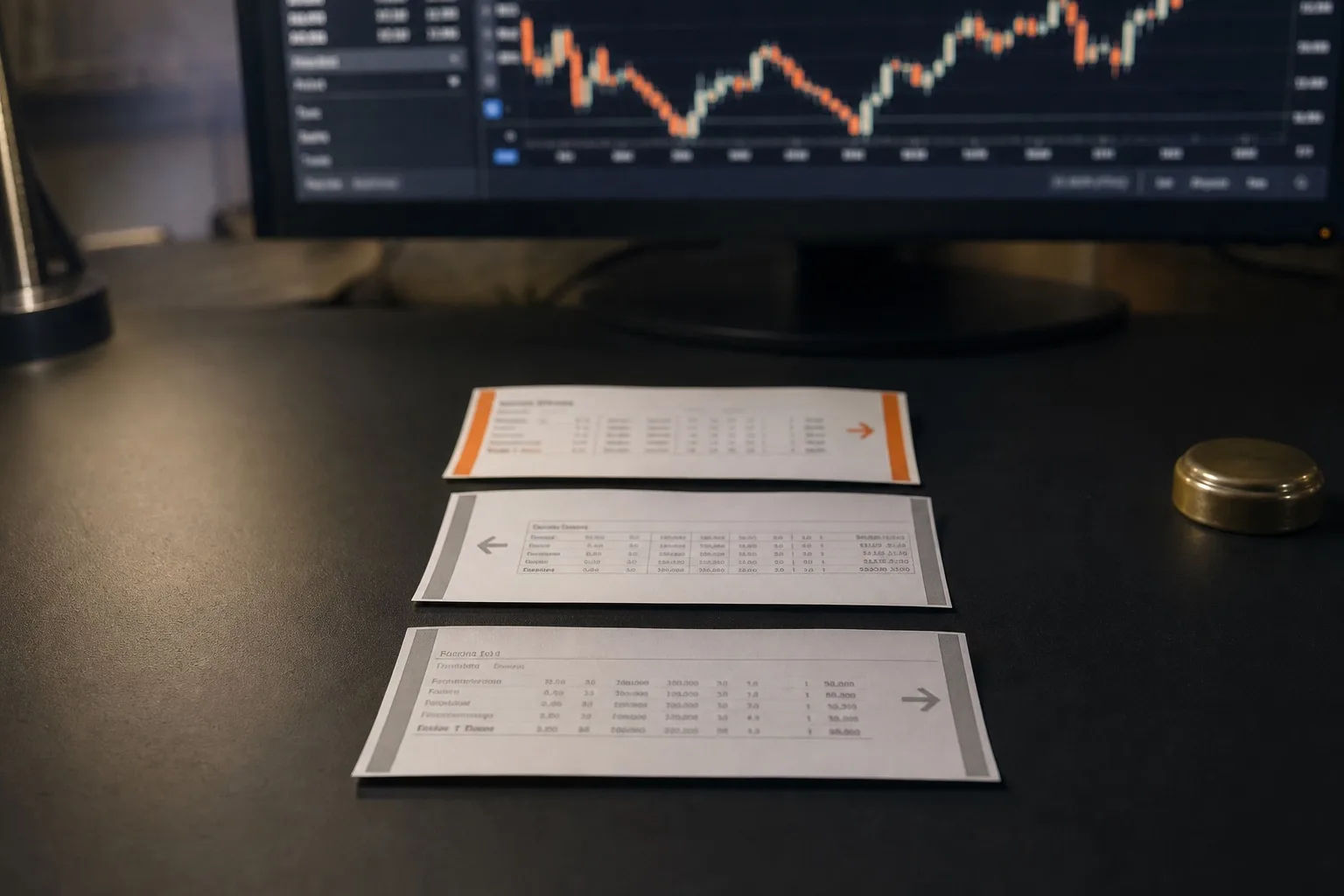
Forex is famous for trading around the clock, but not literally every hour of every week. The market runs continuously for roughly five days — from the Sunday open in Sydney through to the Friday close in New York — and then shuts down for the weekend. [1] That pause is invisible while markets are calm, but it creates one of the most underestimated risks in retail trading: the weekend gap.
What a weekend gap is
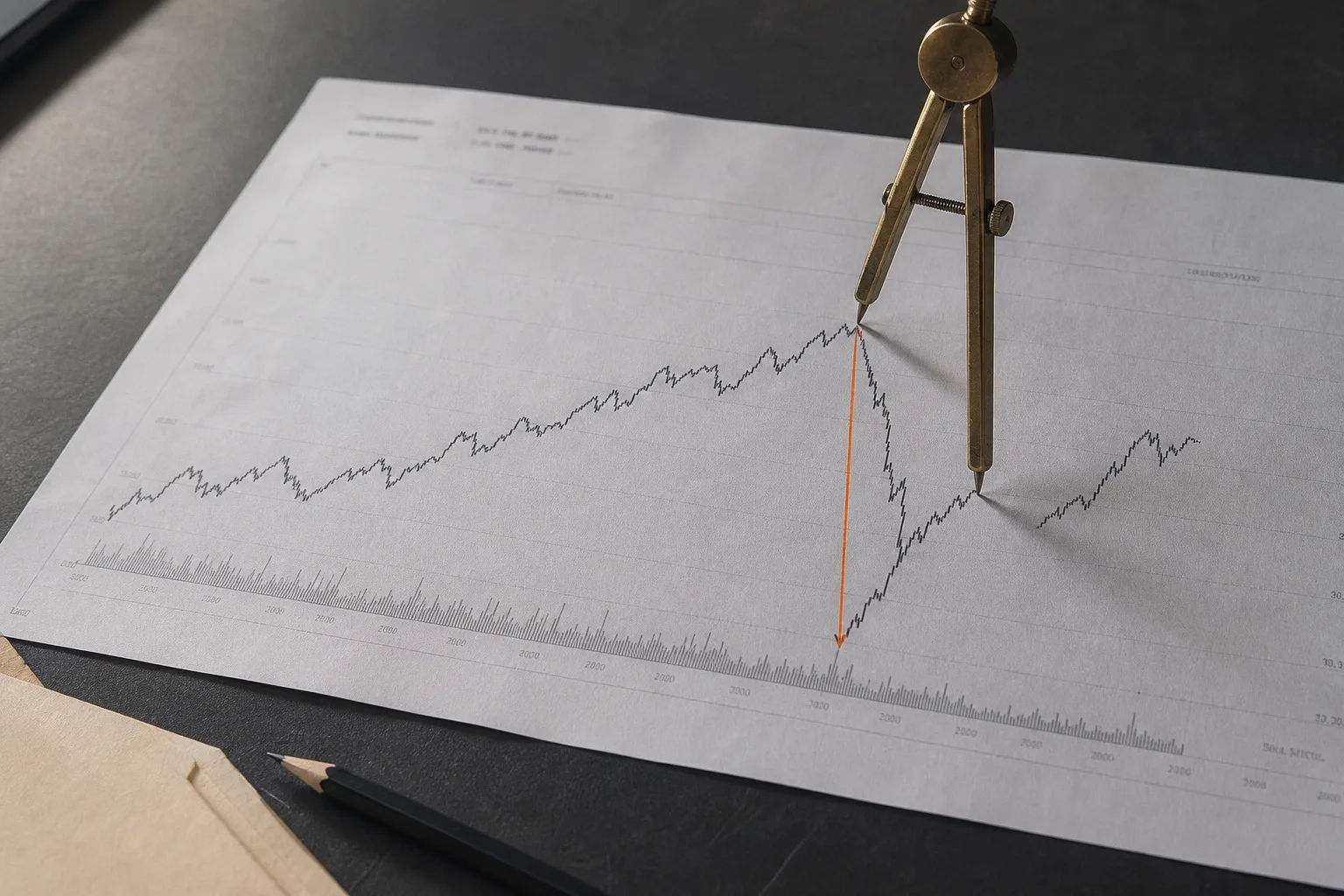
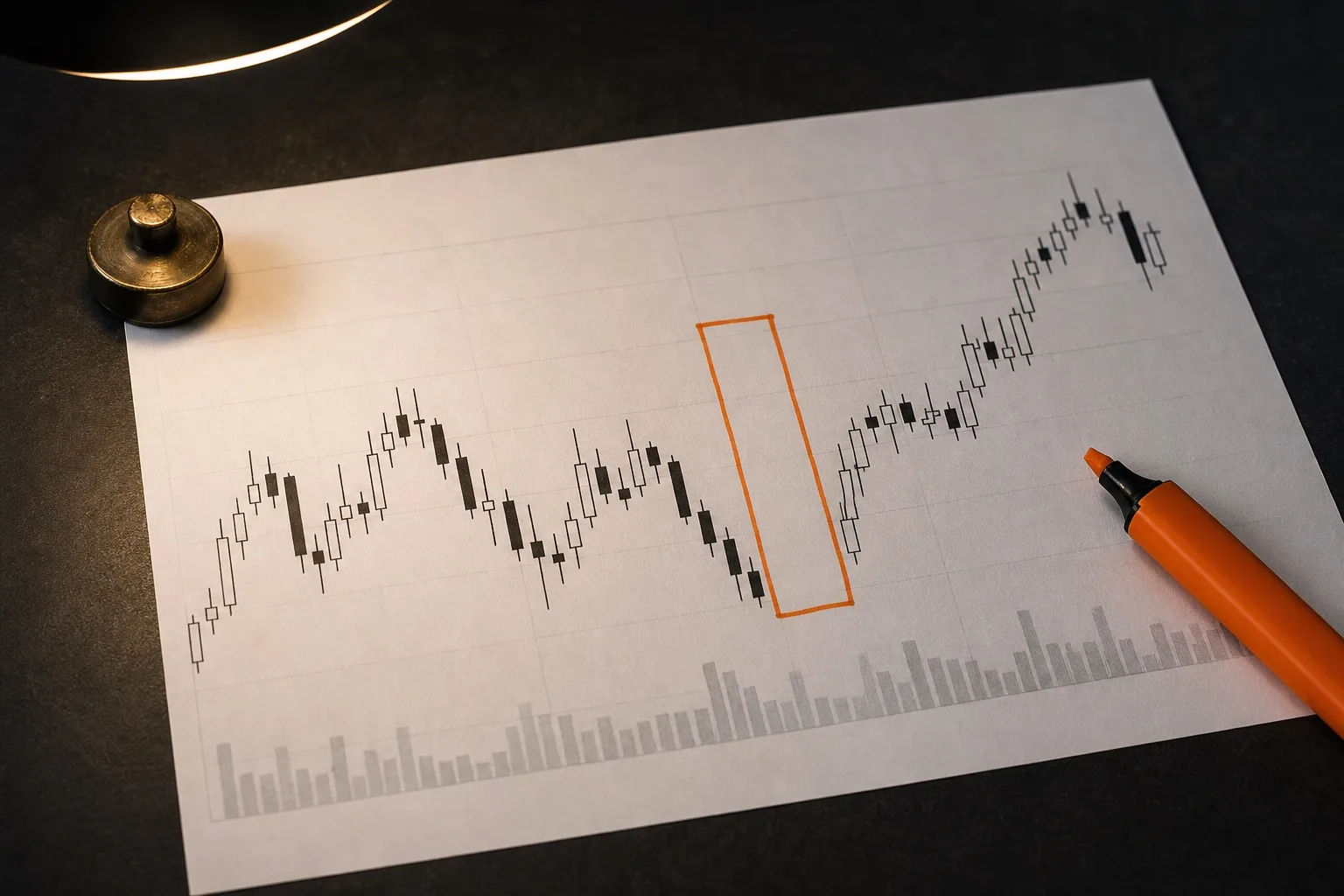
A gap is an area on a chart where no trading takes place. It appears when the price of an instrument changes significantly with little or no trading in between — for example, when the last traded price before a break sits far below the first traded price after the market reopens. [2] On a candlestick chart, a weekend gap is the empty vertical band between Friday's final candle and Sunday evening's first one.
Unlike stock markets, forex does not open at one price and jump to a different one every morning; within the trading week, one financial centre hands over to the next almost seamlessly. The weekend close is the exception — the one scheduled moment when the continuous chain of prices stops completely.
Why the market closes at all
The foreign exchange market is described as continuous: trading 24 hours a day except weekends, running from 22:00 UTC on Sunday (when Sydney starts the week) until 22:00 UTC on Friday (when New York closes it). [1] In practice, broker hours vary. A typical US-centred schedule is approximately 5:00 p.m. Sunday to 5:00 p.m. Friday, New York time — and these times shift with daylight saving changes. [3]
The closure is largely a convention of the interbank and clearing cycle rather than a physical impossibility. Weekends are when the global banking system settles and reconciles, so the wholesale market that retail quotes are built on simply stops producing prices.
Why gaps form over weekends
Because nobody can trade while the market is closed, anything that happens between Friday's close and Sunday's open can only be priced in one jump. Common triggers include:
Political and election surprises. Votes, referendums and policy announcements often land on weekends precisely because traditional markets are shut.
Weekend news and geopolitical events. Conflicts, emergency central-bank statements, and debt negotiations do not respect trading hours.
Thin reopening liquidity. Even without news, the first minutes after the open are the thinnest of the week. With fewer quotes, small order flow can push the opening price away from Friday's close.
The size of the gap is not predictable in advance. Most weekends produce a gap of only a few pips on the majors; occasionally, a major event produces one measured in hundreds of pips.
Where gap risk actually bites: leverage and stops
A gap is dangerous mainly because of what it does to orders. A stop-loss is an instruction to close at the next available price once the trigger level is reached — it does not guarantee execution at the trigger price itself. If the market gaps past your stop, the position is closed at the first traded price after the reopen, which can be far worse than the level you set.
Illustrative example (hypothetical, not real broker data). Suppose you are long 1 standard lot of EUR/USD (100,000 units) over a weekend with a stop 40 pips below Friday's close. If the market reopens 100 pips below Friday's close and your broker fills your stop at the first available price, your loss is roughly 100 pips, not 40. On a pip value of about $10 per standard lot, that is approximately $1,000 instead of the $400 your stop level implied. The extra $600 is the gap slippage. This figure is arithmetic on stated assumptions, not an observation of any real account.
Leverage magnifies the effect because it multiplies the position size that any given pip move translates into. The same gap that a 0.1-lot trader shrugs off can produce a loss several times larger for a trader running high leverage — and, on accounts without negative balance protection, potentially beyond the deposited margin.
How traders handle weekend exposure
There is no single correct answer; the trade-offs are genuine.
Closing positions before the Friday close removes gap risk entirely but also gives up any weekend-position opportunities (e.g. carry accrual) and may incur exit costs in a thin late-Friday market.
Reducing position size for the weekend keeps exposure alive while capping the damage a gap can do — but the remaining position can still gap.
Holding through the weekend preserves carry and avoids churn, at the cost of carrying full gap risk. Note that some brokers charge a separate weekend or extended-hours fee on certain instruments; check your own broker's schedule, which varies.
Traders should also confirm whether their broker offers negative balance protection, since that feature determines whether an extreme gap can produce losses beyond the deposit. Availability varies by jurisdiction and broker.
The takeaway
Weekend gaps are a structural feature of a market that trades continuously for five days and then stops. The core risk is not the gap itself but the leverage sitting underneath it when the market reopens at a new price. Decide your weekend exposure deliberately — size, stop placement realism, and broker-specific hours and protections — rather than by default.
Sources: [1] Wikipedia, Foreign exchange market · [2] Wikipedia, Gap (chart pattern) · [3] OANDA, forex trading hours FAQ.
Sources & further reading
Check the original source for its scope, publication date and latest terms.
- Wikipedia — Foreign exchange markethttps://en.wikipedia.org/wiki/Foreign_exchange_market
- Wikipedia — Gap (chart pattern)https://en.wikipedia.org/wiki/Gap_(chart_pattern)
- OANDA — Forex trading hours FAQhttps://www.oanda.com/forex-trading/hours/
For education and research, not personal investment advice. Trading involves risk. Broker terms and protections depend on your country, account and contracting legal entity.